
“It is never possible to document what was truly lived. Something is always absent, and the things that resist translation remind us that life, above all else, is more precious than its documents.”
Now in its third year, the FluxusMuseum Prize for Experimental Video gathers eleven artists and collectives from a field of over 600 international applications, works chosen for their resistance to easy categorisation, their originality, visual rigour, and an uncompromising approach to the form. Installed across the old marble factory by Parikia’s yacht harbour, the exhibition runs until the end of September, with prize winners announced in mid-September. Ahead of the announcement, we catch up with each of the eleven shortlisted artists and collectives.
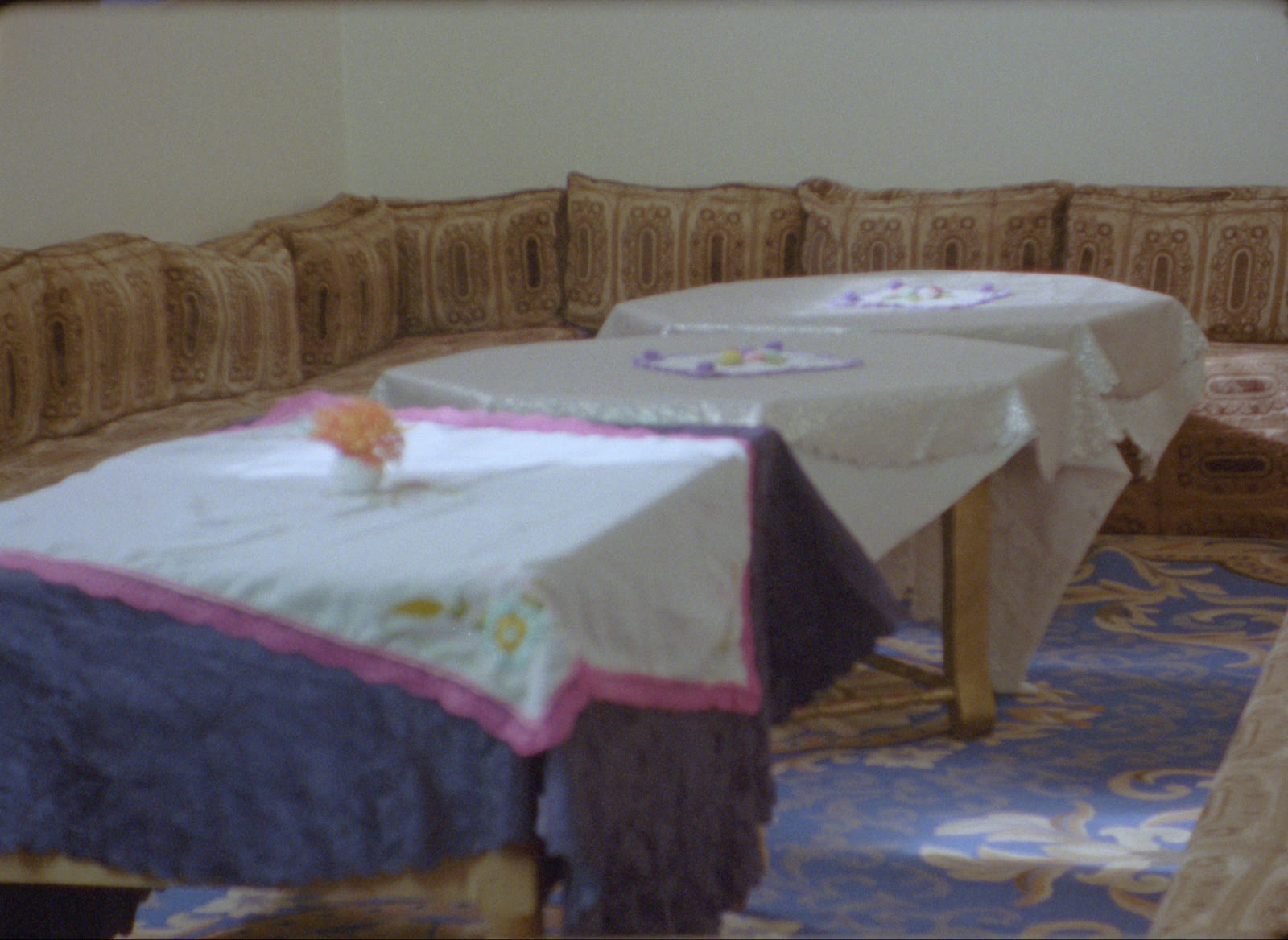
La Otra* is a collective working across anthropology, performance, and video art. Their 16mm film installation footnotes 2*, made with a women's weaving cooperative in Taznakht, southern Morocco, traces how feminine economies and everyday architectures continually rearrange and improvise the spaces around them.
Could you describe your work featuring in the Prize, and how it sits in relation to your practice more broadly?
footnotes 2 is a film installation that explores how feminine economies, everyday architectures, and material ingenuity shape one another through the lived spaces of Taznakht, a small town in southern Morocco. The project emerged from a period of situated research there, where our collective was invited to meet a women's weaving cooperative working out of a kasbah on the town's northern periphery. Our initial intention was to make a 16mm film project centred within this structure, viewing both the kasbah and the carpet as framing devices for a broader conversation about margins, spatial politics, and feminine economies in southern Morocco. The project continues our ongoing series, footnotes, which playfully engages the anthropological tradition of inscription. Rather than using annotation to stabilise meaning, our footnotes operate as counter-ethnographic and poetic interventions that open the image toward multiple voices and possible readings.
What emerged was our understanding that the spaces and architectures we were filming within were less defined by the notion of a margin, and more so by their capacity for modularity. This was manifest in how carpets and furniture are constantly rearranged into new constellations; in how improvised repairs and ephemeral structures are made; and in how the women we were meeting continually assembled the social and material conditions that allowed everyday life to unfold.
It's a wonderful feeling to be so dramatically re-routed in our approach. What emerged was a piece that embraced a moveable and flexible assemblage. The women of Taznakht's cooperative lent us a beautiful carpet, whose designs reminded us of footnoting practices, upon which sitters can view our 16mm piece. The video piece sits close to the floor's ground-line, bringing the viewer close to the ground in the way that Morocco's modular arrangements prioritise the floor as a common frame. And lastly, the piece is inscribed with fragmented "footnotes" that lead you to a small booklet, connecting you with other texts, with moments from our so-called "fieldwork," and with rumours and speculations.
As La Otra*, we are very interested in counter-ethnographic encounters, and the anthropological notion of the "counter-gaze" as an imaginative force. Rather than simply responding to our presence, the women of Taznakht redirected us in ways that materially and conceptually transformed the project. In that sense, the film became less a document of our research than a trace of the relationships through which it was continually remade.
What is your relationship to the moving image as a medium; when did it enter your practice, and what does it let you do that other mediums don't?
Our relationship with the moving image emerges from different trajectories that, upon coming together, began to speak to one another. We come from anthropology, performance, and video art, practices that continue to shape our approach to cinema and our understanding of the possibilities of moving image. We're interested in filmmaking as an embodied and performative practice, both in the gestures of those in front of the camera and those of the people holding it. Documentary and ethnography remain important points of reference for our work, though primarily as traditions we enter into dialogue with, displace, and complicate.
Film offers a particular way of constructing experience, shaping a cadence and gradual process of unveiling. Yet this sense of editorial control always comes after an experience of intense loss of control. During filming, time's speed exceeds any plan; reality never fully conforms to the frame; surprises almost instantly throw our film plans into disarray. Later, in the editing process, another negotiation begins, one between fragments, absences, and our attachments to memory. It is never possible to document what was truly lived. Something is always absent, and the things that resist translation remind us that life, above all else, is more precious than its documents.
Working with 16mm has made us inhabit these conditions with particular attentiveness. The finite duration of each roll, the impossibility of immediately reviewing the footage, and the materiality of the medium all demand a different kind of care. As with many artisanal practices, the material asks for consideration, patience, and intentionality. Every shot is a decision, and every decision means letting go of countless other possible images. Between takes, the conversations we have as collaborators and the rhythms of waiting for the "right light" come to carry the same weight as the moment the camera begins to roll. For footnotes 2, a lot of this time was spent playing with children, since the women of Taznakht are constantly moving through their daily obligations while caretaking. So much of our film was animated by this play, some of the sounds you hear were recorded by these children, and their songs were initially just a sweet way to pass the time while we worked with their mothers. When filming, just as in life, everything is always happening in the spaces between so-called "events."
Are there artists, filmmakers, or traditions outside of art you feel in dialogue with here?
As a collective, we are guided by a promiscuous interest in different knowledge systems and creative practices across geographies and historical moments. Part of what drew each of us to nonfiction comes from our attraction to the meanings embedded in everyday forms of enunciation, silence, articulation, disarticulation, and gesture.
For footnotes 2, the primary tradition we found ourselves in dialogue with was that of the artisan weavers with whom we collaborated. The looms they worked on were often assembled from makeshift objects found around their homes, much like the improvised camera supports and forms of illumination we built from whatever materials happened to surround us. The humour and generosity with which they improvise embodies the kind of grace and responsiveness we hope to cultivate in our own practice.
Alongside this, our collective shares an interest in psychoanalytic frameworks that approach the subconscious as a site of inquiry, a horizon, and an imaginative interlocutor to which we only ever have partial access. As collaborators constantly in conversation about our lives and shared interests, we're often surprised by the synchronicities that emerge between us.
Some people use "experimental" to mean formally unconventional, others to mean something closer to research or inquiry. Which is closer to how you're using video here?
As a collective, our process is experimental in its counter-ethnographic and collaborative impulses: we approach our research and "fieldwork" as a space of creative exchange, where encounters and newly emergent desires can redirect our focus and reshape our priorities. Our visual work experiments too, in its framing, in its nonlinear modes of representation, and in the way it departs from the traditions of non-fiction genres.
Our writing process also requires a collaborative negotiation amongst ourselves. For this project, we attended particularly to crafting an intimacy between the viewer and Taznakht. Rather than offering the sense of authority that comes from knowing information about a place, we wanted to offer footnotes that communicated the affective intimacy of seeing scattered and sensorial glimpses of Taznakht's reality. Our annotations hold fragments of our memories, and recreate our way of approaching Taznakht through what held our attention and through the questions it planted which led us elsewhere.
We also experimented significantly with sound. The Bolex camera's loud mechanical engine interrupts the ability to record synchronous sound while filming. Instead, all sound was captured separately on site and transformed into an accompanying soundscape later in post-production. As we worked through the sound material, we encountered atmospheres and moments that had escaped the visual frame.
What would you like visitors to experience when spending time with your work?
What interests us is creating a space where the encounter with the work can unfold through multiple forms of attention. Rather than proposing a single way of approaching the piece, we hope to create a field of possibilities where each viewer can bring their own forms of literacy to the materials that compose the installation.
The position of the film within the space, situated close to the ground, and the scale of the projection invite a slower and more physical relationship with the moving image. The carpet, woven in Taznakht, extends this invitation through its material presence, allowing the body to participate in the encounter rather than remain outside of it.
Sound also plays an important role in shaping this experience. The soundscape creates an entry point into the work that isn't necessarily tied to what is visible, but instead moves through the body. We are interested in the possibility that someone might watch the film with their eyes closed, or that they might spend time reading the fragments in the booklet rather than following the moving image.
What has the support from FluxusMuseum made possible, for this piece specifically or for your practice more broadly?
As an early-career collective, FluxusMuseum's recognition and support of this project has been deeply transformative. It allowed us to bring into reality a process that depended fundamentally on time, presence, and living relationships. Without Fluxus' support our travel to Taznakht would have been impossible, and we might not have had the boldness to activate the meaningful collaboration that paved our way there.
In every sense, Fluxus' support gave us the courage and motivation to approach the project with greater boldness and imagination. Having the time and resources to follow unexpected directions allowed us to take the risks that ultimately paid off in making the work more expansive than we initially envisioned.
We are grateful to have had the means to follow our gut and to travel to Taznakht, where we are preparing to return and share the film through a community screening.
What else are you working on at the moment?
At the moment, our collective is in advanced development of El Cuenco de la Mano (In The Palm of the Hand), a hybrid film trilogy that embraces fiction, auto-ethnography, and nonlinear narrative experimentation. Inspired in part by the idea that the palm of the hand and the bag were the world's first technologies, this is a film about the things women carry in their hands, on their backs, and in the deepest recesses of their minds. Masculine figures hover out of frame, encircling our characters' stories and shining in their absence.
In addition, we are working on the pre-production process of a short film about women travellers who take pilgrimage cruises along the coastline of Mount Athos, the Greek Orthodox monastic republic that women have been forbidden from visiting since 1060 AD. The monks of the Holy Mountain bring the miraculous icons and relics of the saints to the cruise ships via small boats, and offer their blessings to the women travellers. From the legal limit of 500 metres from the shore, these women use binoculars to trace the famed monasteries of Mount Athos, and lend themselves to our film's exploration of proximity, gendered margins, and apocryphal stories of Mount Athos's successful covert female visitors.

La Otra* are an artistic research and film from Barcelona, Spain. They are: Sol De Caso, Laura Alcalde and Laura Cadena.