← Features · Prize for Experimental Video 2026 · In conversation
In conversation with
Krista Leigh Steinke
“In an era of increasingly automated image-making, working with physical materials becomes a quiet form of resistance.”
Now in its third year, the FluxusMuseum Prize for Experimental Video gathers eleven artists and collectives from a field of over 600 international applications, works chosen for their resistance to easy categorisation, their originality, visual rigour, and an uncompromising approach to the form. Installed across the old marble factory by Parikia’s yacht harbour, the exhibition runs until the end of September, with prize winners announced in mid-September. Ahead of the announcement, we catch up with each of the eleven shortlisted artists and collectives.
Krista Leigh Steinke's practice is grounded in experimentation, material inquiry, and an interest in ecology and the natural world. Her 16mm film yard: work, developed using plant-based chemistry sourced from her own backyard, treats the site as a collaborator rather than a subject.
Could you describe your work featuring in the Prize, and how it sits in relation to your practice more broadly?
My practice is grounded in experimentation, material inquiry, and an interest in ecology and the natural world. Through moving image, experimental photography, installation, and collage, my work offers poetic reflections on time, place, perception, and the interconnections between human experience and the environment. The ebb and flow of nature, the mesmeric qualities of light, and a longing for connection amid the chaos of contemporary life are recurring themes throughout my work.
I often incorporate unconventional methods, including crafting homemade optical devices, repurposing found footage, and collaborating with natural elements. I am especially drawn to analog processes and material experimentation as ways of slowing down and inviting chance into the creative process. In an era of increasingly automated image-making, working with physical materials becomes a quiet form of resistance, emphasising artistic presence, care, and the value of human labour.
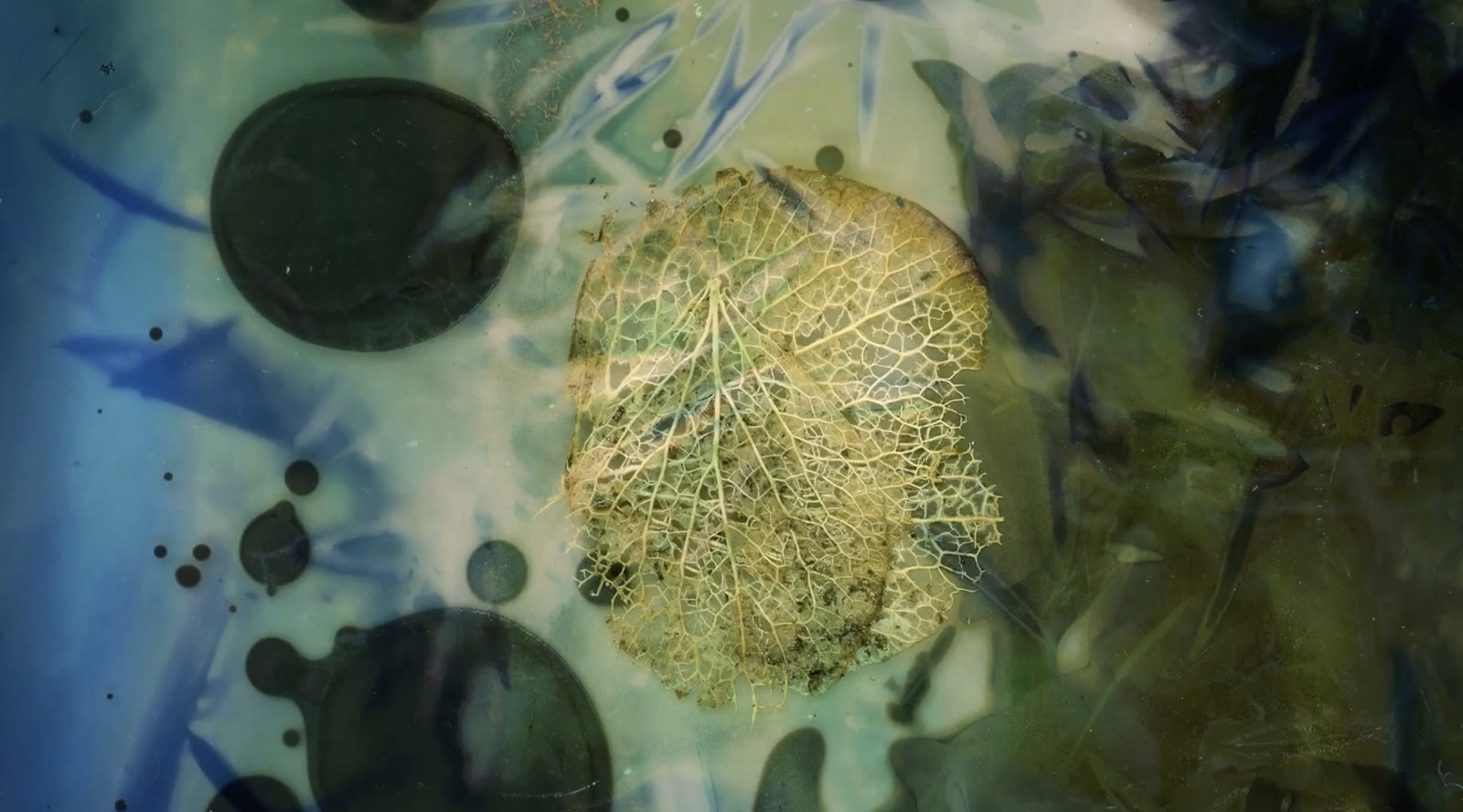
yard: work, my project featured in the Prize, is a strong reflection of my creative interests. The 16mm experimental film is created both about and with my backyard, investigating the space as a site of visual and ecological inquiry. The work incorporates non-toxic, plant-based development processes using ingredients sourced directly from the yard itself. Combined with other eco-friendly techniques, the film's materiality reflects the same cycles of care, labour, and regeneration that characterise the act of tending a yard: intimate, imperfect, and ongoing.
Rather than presenting a fixed narrative, yard: work moves through moments of observation and transformation, inviting an open-ended engagement with the rhythms of place, process, and material. The yard becomes a generative ground for experimentation and play, with film treated as a living medium. On a broader scale, the work suggests metaphors for our relationship to the planet, where small, daily acts of care echo shared responsibilities of stewardship, sustainability, and ecological interdependence.
What is your relationship to the moving image as a medium; when did it enter your practice, and what does it let you do that other mediums don't?
My background is in photo media, so moving image entered my practice as a natural extension of my interest in expanding what a photograph can communicate. I began experimenting with video and film during graduate school, where I approached photography in the broadest sense, working across installation, collage, mixed media, and eventually moving image. Early on, video and film functioned as a complement to my still photographic work and studio explorations. Over time, however, moving image became the central focus of my practice, with my installation, collage, and material experiments often supporting and informing my filmmaking.
I am particularly drawn to the immersive nature of time-based media. Unlike a photograph, which captures a single moment, moving image allows time to unfold. It creates space for anticipation, rhythm, pacing, and transformation, while opening up a dynamic relationship between image and sound. Through editing, I can create poetic associations and layer meaning through the juxtaposition of images, sounds, and sequences.
What attracts me most is that, in moving image, "time" becomes part of the artistic palette. Meaning emerges not only through individual images, but through their duration, sequencing, and rhythm. Through shifts between light and dark, movement and stillness, rhythm and pause, I can create experiences that unfold moment by moment. I often think of the difference between a still photograph and a film as the difference between a single fabric swatch and an entire patchwork quilt. Each image holds its own significance, but together they form a larger, more layered experience.
Are there artists, filmmakers, or traditions outside of art you feel in dialogue with here?
My work is informed by environmental art, mid-century experimental film and animation, and improvisational experimental music. I am particularly drawn to traditions that embrace process and material responsiveness, from the chance-based compositions of John Cage to the abstract material explorations of Stan Brakhage. In all of these, the process of making is valued as much as the final form.
Conceptually, my film draws from ecofeminism, ecomaterialism, and ecological philosophy. Thinkers such as Linda Weintraub, Timothy Morton, Donna Haraway, and Robin Wall Kimmerer have shaped my understanding of the human-environmental relationship. Although perspectives differ, they all stress that we are not separate from nature but intrinsically connected, positioning us as participants within a larger ecological network.
I am also currently researching pioneering women from history whose creative practices were shaped by their interest in botany and nature, including Anna Atkins, Emily Dickinson, Beatrix Potter, Hilma af Klint, Maya Deren, and Ana Mendieta. While their work spans different disciplines and historical moments, I feel my creative lineage is deeply connected to the ways they merged artistic inquiry, scientific curiosity, spirituality, and embodied relationships with the natural world. Their legacies continue to inform how I think about art-making as a form of dialogue with nature.
Some people use "experimental" to mean formally unconventional, others to mean something closer to research or inquiry. Which is closer to how you're using video here?
This is an interesting question because, in my work, these two meanings of "experimental" are intertwined.
On one level, yard: work is formally experimental in the way it was made. The film incorporates plant-based developers, cameraless photography, and other sustainable analog techniques that move beyond conventional filmmaking processes. However, those formal decisions emerged through research, material investigation, and hands-on experimentation. Developing the film required learning about the chemistry of plants and their interaction with photographic materials, while the work itself became a form of visual inquiry into the ecosystem of my backyard.
The project was created both about and with the backyard, approaching the site as a collaborator rather than simply a subject. Sunlight, soil, weather, and plant matter all left traces on the film, introducing organic distortions, stains, and irregularities that shaped its visual language. Shifting between representational imagery and abstraction, the film explores how natural processes and human actions intersect over time.
More broadly, a curiosity about materials and techniques is what drives my work as an experimental artist. I like to reveal "the magic behind the curtain," leaving traces of how I manipulate and transform film media. I value the process as much as the final product and intentionally showcase flaws, glitches, and scratches, elements filmmakers typically try to conceal. In this way, the work not only uses film as a medium but also reflects on the medium itself. Audio, such as the ambient sound of the film projector, further underscores this relationship.
For me, experimentation is ultimately a way of generating knowledge. In yard: work, the film's physical transformations mirror the ecological cycles and relationships the work explores. The result is both an unconventional form and an ongoing inquiry into the intertwined nature of material, media, environment, and perception.
What would you like visitors to experience when spending time with your work?
In yard: work, the backyard is a creative partner rather than simply a setting, emphasising how acts of attention, care, and collaboration can shape our relationship to the places we inhabit.
My goal was to create a portal for reflecting on ecology not through a purely scientific framework, but as something dynamic, expressive, aesthetic, and accessible, a way of rendering ecological concepts as something to be felt rather than merely understood. I hope viewers experience a heightened sense of interconnectedness, both with the natural world and with the often-overlooked forms of care and labour required to sustain everyday life.
Ultimately, the project suggests that nature offers endless lessons, insights, and creative possibilities if we take the time to engage, participate, and remain open to what it can teach us. I am less interested in delivering a fixed message than in creating space for curiosity, contemplation, and discovery. If viewers leave with a renewed awareness of the living systems around them, or a deeper appreciation for the mysteries that emerge through close engagement with their surroundings, then the work has succeeded.
What has the support from FluxusMuseum made possible, for this piece specifically or for your practice more broadly?
The support from FluxusMuseum came at an important moment in my practice, making it possible for me to pursue a direction I had been wanting to explore for some time: integrating more sustainable, environmentally conscious materials and processes into my work. Creating yard: work provided the opportunity to research and refine plant-based film developers and other eco-friendly analog techniques, making material experimentation central to the project.
The film also enabled a more open-ended creative process shaped by chance, emergence, and collaboration with the natural world. Rather than following a fixed sequence, the work evolved through a dialogue between intention and unpredictability, transforming everyday elements of the backyard into sources of discovery and creative possibility.
Most importantly, the experience has deepened my engagement with ecology and material inquiry while helping me develop a more sustainable approach to image-making. The insights gained through yard: work will continue to shape how I approach process, materials, and environmental responsibility in future projects.
What else are you working on at the moment?
I recently completed a film commission for the Alexandria Museum of Art based on Emily Dickinson's poem I Dwell in Possibility. For that project, I repurposed footage from yard: work, combining it with moving text to create a meditation on the poem. Both of these recent works have sparked new ideas and directions that I am continuing to explore.
A long-term project currently in development is a series of short films informed by ecofeminist ideas, linking personal experience with the natural world. Each work will employ its own subject matter and material approach while remaining connected through shared themes and conceptual threads. I think of the series as a collection of short stories that can be experienced individually or as a larger body of work.
I am also beginning to experiment with microscopy and 16mm direct animation, while continuing to explore sustainable film development techniques, the intersection of analog and digital processes, and collaborations with insects such as ladybugs and fireflies.
On a lighter note, I purchased a vintage bass guitar this summer, so I suspect music may play a larger role in my future filmmaking.

Krista Leigh Steinke is an interdisciplinary artist working in moving image, experimental photography, installation, and collage.